
Vocational Education and Training (VET) plays an important role in preparing people for employment, but its purpose is changing. Learners now need to be ready for digitalisation, the green transition and rapidly changing labour-market requirements. At the same time, VET systems must respond to increasingly diverse groups of learners.
For this reason, inclusion and future-oriented teaching should be considered together. A future-ready VET system should not only prepare learners for new occupations and technologies, but also make learning accessible to people with different abilities, backgrounds and circumstances. The OECD highlights flexibility and inclusion as key features of strong and responsive VET systems (OECD, 2023).
Designing learning for different needs
Inclusive teaching begins with recognising that learners do not all learn in the same way. Some may need additional support with written materials, while others may benefit more from demonstrations, practical activities or visual resources.
Universal Design for Learning encourages teachers to plan lessons that offer different ways of accessing information, taking part in activities and demonstrating knowledge (CAST, 2024). In VET, this can include combining written instructions with videos, demonstrations and practical exercises. This approach does not reduce academic or professional standards. Instead, it removes unnecessary barriers and gives learners more opportunities to show what they can do.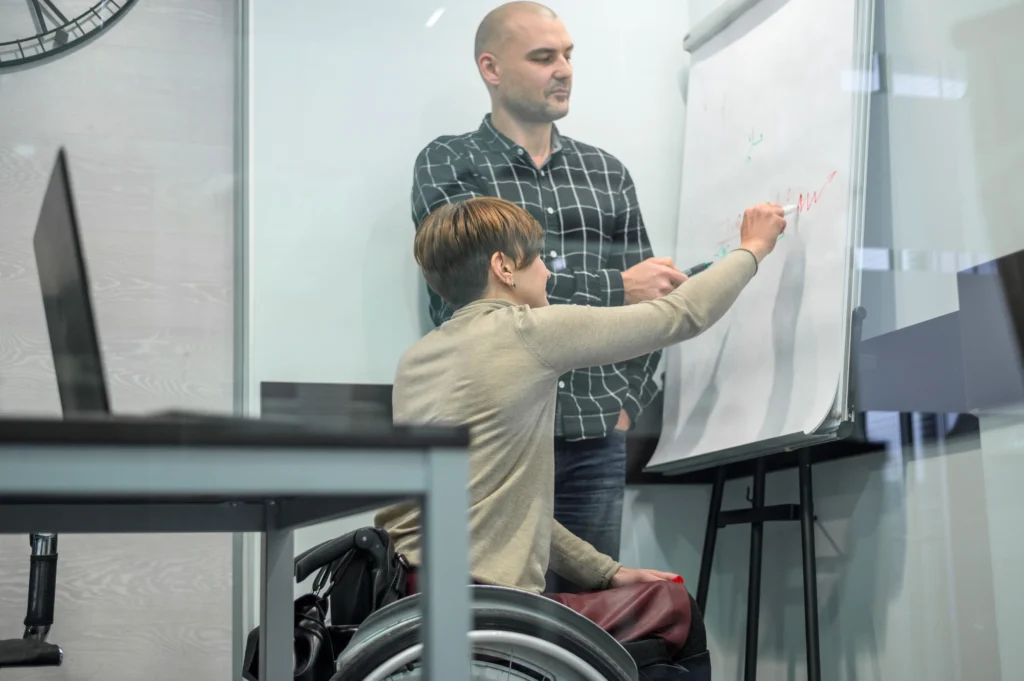
Source: Magnific
Using active and learner-centred approaches
Future-oriented VET should also encourage learners to participate actively in their education. Project-based learning, collaborative tasks and problem-solving activities can help students develop both technical and transferable skills. The OECD identifies active learning approaches as useful for developing communication, teamwork, creativity and critical thinking alongside occupational skills (OECD, 2023). For example, construction students could analyse how to reduce waste in a building project, while hospitality students could design an accessible event for customers with different needs. Such activities make learning more realistic and allow students with different strengths to contribute.
Inclusive use of technology
Digital tools can make VET more flexible and engaging. Simulations, virtual learning environments and online resources can help learners practise technical tasks and study at a time that suits their personal circumstances. Technology can improve access to VET, but it can also create new barriers. Some learners may not have suitable devices, reliable internet access or enough digital confidence. Digital materials may also be inaccessible to people with certain disabilities. The European Commission stresses the importance of improving digital access and the digital capacity of education providers (European Commission, 2020). Technology should therefore be introduced in ways that support inclusion rather than assume that all learners have the same resources and skills.
Flexible learning pathways
Inclusive VET should also provide different ways to participate in education. Adult learners, people returning to education, migrants and those combining study with employment or caring responsibilities may need more flexible options.
Part-time courses, blended learning, modular programmes and recognition of prior learning can make education more accessible. The OECD identifies flexible provision and recognition of existing skills as important ways of supporting lifelong learning (OECD, 2023). These approaches are particularly relevant because workers are increasingly expected to update their skills throughout their careers.

Source: Magnific
Preparing learners for future workplaces
VET must prepare learners for digital and green transitions as well as for current jobs. UNESCO places digital, green and inclusive transformation at the centre of its strategy for vocational education and training (UNESCO, 2022). This means that learners need more than occupation-specific technical skills. Digital literacy, environmental awareness, communication, problem-solving and adaptability are becoming essential parts of vocational competence. These skills are most effective when connected with practical vocational activities. Sustainability, for example, can be taught through reducing waste and energy use in a particular occupation rather than as a completely separate subject.
Supporting teachers and trainers
Teachers are central to making VET both inclusive and future-oriented. They need to combine teaching skills with up-to-date professional knowledge and an understanding of changing workplace requirements. Cedefop emphasises that VET teachers increasingly need competences connected with digitalisation, inclusion and changing labour-market demands (Cedefop, 2022). The OECD also describes VET teaching as a „dual profession”, requiring expertise in both education and industry (OECD, 2021). Teachers therefore need continuing professional development, opportunities to cooperate with employers and access to appropriate digital and teaching resources.
Conclusion
Making VET more inclusive is not only about increasing access to education. It is about ensuring that learners can participate fully, develop useful skills and successfully move into employment or further learning. Future-oriented teaching approaches can support this aim through flexible learning, active teaching methods, inclusive technology, accessible assessment and stronger links with workplaces. A strong VET system should prepare people for changing technologies and occupations while recognising that learners have different needs and experiences. When inclusion is built into teaching from the beginning, VET becomes both fairer and better prepared for the future.
References
CAST. (2024). CAST Universal Design for Learning guidelines version 3.0. CAST.
Cedefop. (2022). Teachers and trainers in a changing world: Building up competences for inclusive, green and digitalised vocational education and training (VET): Synthesis report. Publications Office of the European Union.
European Commission. (2020). Digital Education Action Plan 2021–2027: Resetting education and training for the digital age. European Commission.
OECD. (2021). Teachers and leaders in vocational education and training. OECD Publishing.
OECD. (2023). Building future-ready vocational education and training systems. OECD Publishing.
UNESCO. (2022). UNESCO strategy for TVET 2022–2029: Transforming technical and vocational education and training for successful and just transitions. UNESCO.