
In today’s rapidly changing world, organisations can no longer rely on past success or established practices alone. The pace of technological innovation, evolving regulations, demographic shifts, and other global developments is accelerating, creating an increasingly complex and interconnected environment. These megatrends do not operate independently; rather, they influence and reinforce one another, reshaping economies, labour markets, and education systems. To remain relevant and resilient, organisations-including vocational education and training (VET) providers-must adopt a forward-looking perspective, anticipate change, and develop strategies that enable them to respond proactively to emerging challenges and opportunities (EY 2024).
What is a megatrend?
Megatrends are large-scale, long-term forces that influence economies, societies, and global development. They are based on observable evidence and supported by research and data, making them more than temporary trends or predictions. Because they shape the way people live, work, and learn over many years, megatrends create both significant challenges and new opportunities for individuals, organisations, and policymakers. Although the concept has existed for decades, it remains highly relevant today, as businesses, governments, and educational institutions increasingly use megatrend analysis to guide strategic planning and prepare for future change (PwC, 2016).

Source: Magnific
| Demographic shift
Demographic change is one of the most influential megatrends shaping the future of societies, economies, and education. While many developed countries are experiencing ageing and declining populations, other regions continue to grow rapidly, resulting in expanding labour forces and increasing demand for education and employment opportunities. These contrasting demographic patterns are transforming labour markets by creating skill shortages in some sectors and a growing need for workforce development in others. At the same time, longer life expectancy and changing career paths mean that people will need to update their skills throughout their working lives. For vocational education and training (VET) providers, this highlights the importance of offering flexible, lifelong learning opportunities that meet the needs of both younger learners entering the labour market and older adults seeking to reskill or upskill. Addressing demographic change will therefore require education systems to become more inclusive, adaptable, and responsive to evolving workforce demands (PwC 2016).
Proportion of the world population aged 60 years or more
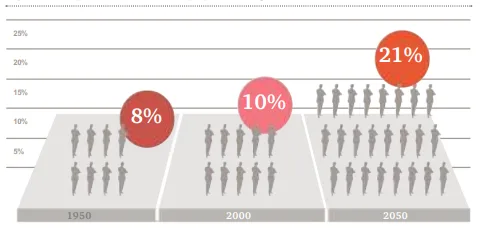
Source: UN report World Population Ageing 1950-2050
| Digital transformation
Digital transformation has become a fundamental megatrend that enables organisations to respond effectively to rapid technological and market changes. By modernising digital infrastructure, adopting cloud-based technologies, and improving organisational processes, institutions can enhance efficiency, innovation, and long-term resilience. These developments also improve access to digital tools and services, allowing individuals to work and learn more effectively. For vocational education and training (VET) providers, digital transformation requires integrating digital technologies into teaching, learning, and organisational management while equipping learners with the digital skills needed in an increasingly technology-driven labour market (Synechron 2025).
| Climate change and resource scarcity
Climate change is a global megatrend that is intensifying environmental risks while increasing pressure on natural resources, economies, and societies. More frequent extreme weather events, rising temperatures, and resource scarcity are disrupting livelihoods, infrastructure, and labour markets, with the greatest impacts often falling on vulnerable populations. These challenges are closely linked to growing social and economic inequalities, highlighting the need for sustainable development and resilient public policies. For vocational education and training (VET) providers, this megatrend underscores the importance of preparing learners with green skills, environmental awareness, and the competencies needed to support climate adaptation and the transition to a more sustainable economy (UN ESCAP, 2024).
With a population of 8.3 billion people by 2030, we’ll need…
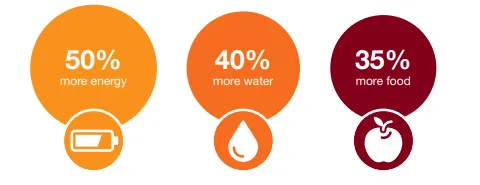
Source: National Intelligence Council: Global Trends 2030: Alternative Worlds.
| Artificial intelligence
Artificial intelligence (AI) has become one of the most transformative megatrends, reshaping industries, workplaces, and education through its rapidly expanding capabilities and applications. Rather than replacing human expertise, AI is increasingly used to enhance productivity, support decision-making, and automate routine tasks. As AI technologies become more integrated into everyday work, organisations must adopt responsible and ethical approaches while ensuring that employees possess the skills needed to use these tools effectively. For vocational education and training (VET) providers, this means embedding AI literacy, digital competencies, and critical thinking into curricula to prepare learners for an evolving labour market where collaboration between humans and AI is becoming the norm (Synechron 2025).
| Shift in global economic power
The global economy is undergoing a long-term shift as emerging economies, particularly in Asia, gain increasing influence in global trade, investment, and innovation. While advanced economies remain important drivers of economic growth, countries such as China, India, and other rapidly developing nations are playing an increasingly significant role in shaping international markets and global value chains. This redistribution of economic power is changing the demand for skills, accelerating international competition, and creating new opportunities for cross-border collaboration. For vocational education and training (VET) providers, this megatrend highlights the need to prepare learners for a globally connected labour market by developing international competencies, intercultural communication skills, and the flexibility to adapt to changing economic conditions (OECD, 2019); (European Commission, 2025).
GDP of G7 and E7 countries (US$)[1]
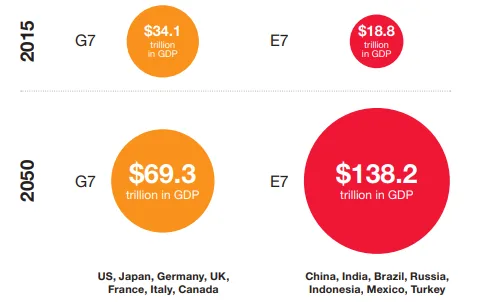
$). SourceL PwC analysis
| Key takeaways
The five megatrends discussed in this article demonstrate that the future of vocational education and training (VET) will be shaped by profound technological, demographic, environmental, and economic changes. To remain relevant, VET providers must adopt a proactive and future-oriented approach by continuously adapting curricula, teaching methods, and institutional strategies to evolving labour market needs. By anticipating these developments rather than reacting to them, VET institutions can equip learners with the knowledge, skills, and resilience needed to succeed in an increasingly complex and interconnected world.
| References
European Commission. (2025). The future of European competitiveness. https://commission.europa.eu/topics/eu-competitiveness/draghi-report_en
Ernst & Young (EY). (2024). Five megatrends shaping the world. https://www.ey.com/en_us/insights/family-enterprise/five-megatrends-shaping-the-world
National Intelligence Council. (2012). Global trends 2030: Alternative worlds. https://www.dni.gov/files/documents/GlobalTrends_2030.pdf
Organisation for Economic Co-operation and Development. (2019). The future of work: OECD employment outlook 2019. OECD Publishing. https://www.oecd.org/employment-outlook/2019/
PwC. (2016). Five megatrends and their implications for global defense & security. https://www.pwc.com/gr/en/publications/assets/five-megatrends-and-their-implications-for-global-defense-and-security.pdf
Synechron. (2025). CTOs: These five megatrends will impact businesses next year. https://www.synechron.com/insight/ctos-these-five-megatrends-will-impact-businesses-next-year
United Nations Economic and Social Commission for Asia and the Pacific. (2024). Crossroads of risk: The climate change megatrend. https://socialoutlook.unescap.org/2024/crossroads-risk-climate-change-megatrend
United Nations. Department of Economic and Social Affairs, Population Division. (2002). World population ageing: 1950–2050. https://www.un.org/development/desa/pd/content/world-population-ageing-1950-2050
[1] The G7 (Group of Seven) comprises Canada, France, Germany, Italy, Japan, the United Kingdom, and the United States. The E7 (Emerging Seven) refers to seven major emerging economies: Brazil, China, India, Indonesia, Mexico, Russia, and Türkiye.