
Preparing VET for different futures
Vocational education and training is expected to prepare people for real jobs. The difficulty is that many of those jobs are changing faster than training programmes can be updated. New technologies enter workplaces, companies reorganise tasks, environmental requirements create new skills needs, and some occupations combine technical and digital work in ways that were uncommon only a few years ago.
For VET providers, waiting until these changes are fully visible can create a delay. A new skills need may already be important for employers while it is still missing from a training programme. Scenario planning can help reduce this gap.
Instead of trying to predict one exact future, scenario planning looks at several possible ways in which a sector, occupation or workplace could develop. VET providers can then consider what each possibility would mean for skills, teaching and curriculum development. This approach fits well with foresight because it encourages educators to prepare for change before it becomes an urgent problem.
| What is scenario planning?
Scenario planning is a foresight method used to explore different possible futures. A scenario is not a forecast. It does not say what will definitely happen. It describes what could happen if important trends and uncertainties develop in a particular way.
This distinction is useful for VET. Labour market forecasts can show expected employment or skills trends, but they cannot fully predict technological breakthroughs, regulatory changes or how quickly employers will adopt new solutions. Scenario planning allows these uncertainties to be discussed rather than ignored.
Cedefop and the International Labour Organization recognise scenarios as one of the methods that can support skills anticipation. They can be combined with forecasts, labour market information, expert knowledge and stakeholder consultation to give a broader view of future skills needs.
| Looking beyond one expected future
Consider a VET programme for automotive technicians.
One possible future is a fast move towards electric vehicles. Another is a slower transition in which electric, hybrid and conventional vehicles remain on the road together for many years. A third possibility is that software, sensors and remote diagnostics become more important than expected. Each future creates a slightly different skills profile. In the first case, learners may need more knowledge of high-voltage systems and battery safety. In the second, technicians may need to work confidently with several types of vehicle technology. In the third, digital diagnostics and the ability to interpret data may become central parts of the job.

Source: Magnific
The VET provider does not have to decide which future is correct. It can look for skills that remain useful in several scenarios. Electrical safety, digital diagnostics, problem-solving and the ability to learn new systems may appear important under all three.
These are stronger signals for curriculum planning than a decision based on only one prediction.
Cedefop’s recent foresight work uses this same principle. Its Preparing for 2040 study explores several possible futures instead of assuming a single development path, using trends and uncertainties to build alternative scenarios.
| Building scenarios with employers
Scenario planning becomes more useful when VET providers do not work alone.
Employers have direct knowledge of what is happening in workplaces. They know which tasks are becoming more difficult to recruit for, which technologies companies are considering and which skills are missing among new workers. Teachers and trainers bring another perspective. They understand learners, qualifications, teaching time and what can realistically be introduced into a programme.
Bringing these views together can produce scenarios that are both future-oriented and grounded in practice.
This type of cooperation is directly relevant to the SkillWIZ approach. The project’s workshop and activity templates are intended to help VET trainers work with different stakeholders and co-create future scenarios rather than treating foresight only as an individual analytical task.
| From scenarios to curriculum decisions
Suppose several scenarios for the construction sector show growing demand for workers who understand energy efficiency, digital building systems and sustainable materials. The VET provider does not necessarily need to create a new qualification immediately.
A first response could be smaller. A new practical exercise could be added to an existing course. Teachers could receive short training. A company could provide access to new equipment during work-based learning. A new module could be tested before becoming part of the full programme. This makes scenario planning useful for faster adaptation. OECD analysis of VET development notes that curricula have to respond to changing labour market needs while also going through processes connected with learning outcomes, qualification frameworks, stakeholder consultation and approval. New digital tools and better skills intelligence are increasingly being explored as ways to make this process more responsive.
The SkillWIZ project follows a similar practical direction. Its aim is not simply to teach educators about foresight as a concept, but to help them use foresight when adapting curricula, training activities and institutional strategies.
| Preparing before the change becomes urgent
This is one of the main advantages of scenario planning for VET. A traditional response often begins after a problem is already visible. Employers report a shortage, educators identify a curriculum gap, consultations begin and changes are prepared. Scenario planning moves part of this work earlier. When a possible development has already been discussed, a VET institution can prepare options in advance. Teachers may already know which module needs revision. Employer partners may already be identified. Equipment needs may already have been discussed. The institution is not predicting the future. It is reducing the time needed to react.
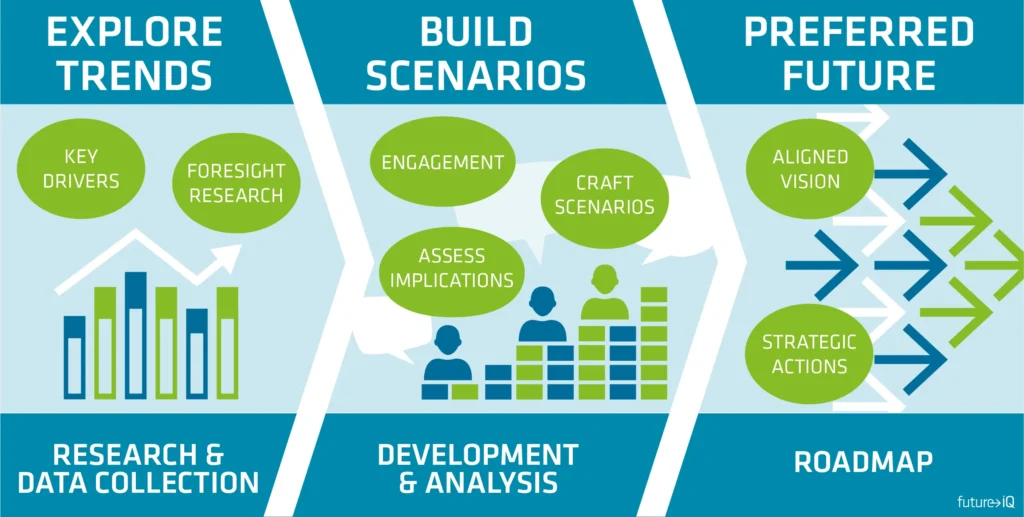
Source: https://future-iq.com/specialised-methodology/strategic-scenario-planning/
This matters because the digital and green transitions are already changing the demand for skills across sectors. European policy places strong emphasis on upskilling and reskilling so that workers and businesses can adjust to these transitions.
| Key takeaways
Scenario planning gives VET providers a practical way to prepare for change without trying to predict the future exactly. By exploring several possible developments, educators can identify skills that are likely to remain useful under different conditions.
The method becomes especially valuable when employers and other stakeholders are involved. Their knowledge can help VET providers understand early signals from the workplace and translate them into practical training decisions. For VET institutions, the main benefit is time. Thinking through possible changes in advance makes it easier to adjust curricula, teacher skills, work-based learning and training resources when those changes begin to happen. For learners, it can mean training that is better prepared for the jobs they will enter, not only the jobs that exist today.